How the Board of County Commissioners Handles Quasi-Judicial Proceedings Involving Land Use

In a quasi-judicial proceeding involving land use, the El Paso County Board of County Commissioners is not making broad public policy or simply weighing which side has greater public support. Instead, the Board must consider a specific land use request, evaluate the evidence presented during the hearing, apply the applicable criteria in the County’s Land Development Code, and ultimately make a decision based on the record before it.

That distinction is important to understanding the hearing process and why the applicant and members of the public have different procedural roles.

The applicant (the property owner seeking approval of the requested land use action) carries the burden of demonstrating that its application satisfies the applicable approval criteria. For that reason, the applicant presents its case to the Board, may use an electronic presentation and other exhibits to present its evidence, and is provided an opportunity for rebuttal after public evidence is received. Those procedures are not intended to favor the applicant’s position. Rather, they mirror the way court hearings work and reflect the applicant’s distinct legal role and burden in a quasi-judicial proceeding and help ensure that the Board develops a complete record upon which it can make a legally defensible decision.

Members of the public may provide relevant evidence supporting or opposing the application, and the Board considers that information as part of its decision-making process. All members of the public are subject to the same procedures regardless of whether they support or oppose the application. Fairness in this context therefore means that similarly situated participants are treated consistently; it does not necessarily mean that the applicant, which bears the legal burden of proof, and individual public speakers have identical presentation procedures or amounts of time.

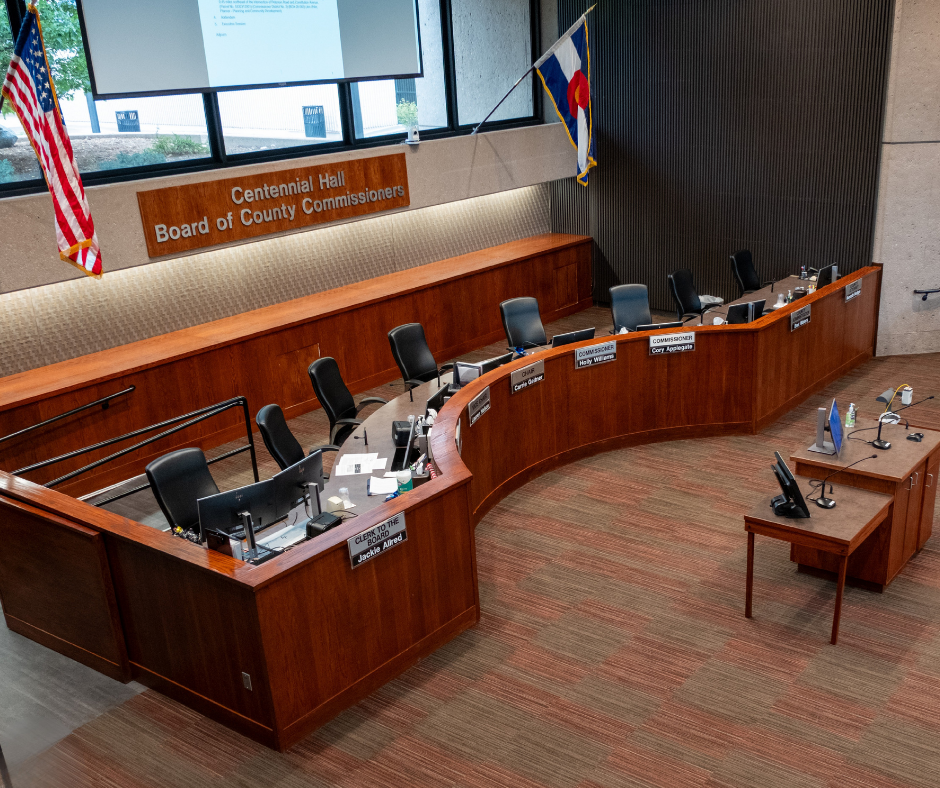
Centennial Hall auditorium over looking the Board of County Commissioners dais.

The Board’s adopted Legislative and Parliamentary Rules and Procedures expressly place responsibility for conducting public meetings and hearings with the Chair. Those rules give the Chair discretion to determine the order of speakers, establish and enforce reasonable speaking times in a fair manner, maintain decorum, limit repetitive or cumulative testimony, and manage the hearing to ensure a full, fair, orderly, and efficient process.

If the Board anticipates a significant level of public interest for a hearing, the Chair may need to adjust the standard speaking time so that as many members of the public as possible have an opportunity to be heard. A potential time between one and three minutes per speaker would therefore not be intended to diminish the importance of public testimony or any particular viewpoint. It would be a practical means of expanding access to the process by allowing a large number of people to personally address the Board while maintaining an orderly and manageable hearing. Most importantly, whatever individual time limit is established for public speakers will be applied consistently, regardless of whether a speaker supports or opposes the application.

For similar reasons, the Chair may determine that individual electronic presentations cannot reasonably be accommodated during public evidence. With potentially hundreds of participants, repeatedly connecting, loading, displaying, and transitioning between individual presentations could consume substantial hearing time and create logistical difficulties that reduce the amount of time available to hear from residents. The County’s display of externally prepared electronic presentations is a courtesy rather than a procedural right, and the Chair may reasonably determine how those materials can be accommodated while ensuring consistent treatment of public participants.

This is different from the applicant’s electronic presentation. Because the applicant bears the burden of proof, it must be afforded a reasonable opportunity to present the evidence it believes demonstrates that the application satisfies the County’s approval criteria. The applicant’s presentation is therefore part of its formal case to the Board, rather than public comment, and the applicant remains responsible for establishing the factual and legal basis for the requested approval.

The Board’s regular meeting start time is 9:00 a.m. Maintaining the Board’s established meeting time provides consistency and avoids changing the normal process based upon the identity of an applicant, the subject matter of an application, the amount of public interest it generates, or the anticipated viewpoints of those participating. That consistency is another important component of maintaining a fair and impartial quasi-judicial process.

Ultimately, the purpose of these procedures is to provide the applicant the process necessary to meet its legal burden, provide members of the public an opportunity to present relevant evidence and testimony, treat similarly situated public participants consistently, and give the Board the record it needs to evaluate the application under the applicable land use criteria.

Accordingly, the Chair will determine how public testimony and the hearing are conducted consistent with the Board’s adopted rules and the circumstances presented that day. The County is confident those procedures provide the appropriate framework for public participation while allowing the Board to conduct a full, fair, orderly, and legally sound quasi-judicial hearing.

Page divider with El Paso County, Colorado seal
